Out of all places that astonish you, this one combines honour, sacrifice and bravery like never before. The dramatic plains of southern Rajasthan is home to a historical monument, where emotions are etched in stone. It is the Chittorgarh Fort. A place where sacrifice became a way of life, and courage witnessed the toughest battles.
Designated as a UNESCO World Heritage Site, Chittorgarh Fort is among the largest forts in India. It has a significant place in Indian history. Just as you walk through its gates, you get to hear legends of valiant warriors, devoted queens and saint-poets. Ready to explore the fort? Let’s go ahead to see everything it has for you.
Diving Into Chittorgarh Fort’s History
When you think of forts of India, they often have spine-chilling stories to tell. From wars to the power of dynasties to their destructive eras, there is so much these forts have witnessed. Even the origins of Chittorgarh Fort date back to the 7th century. Do you know it is believed to have been established by the Maurya dynasty? Over time, the fort passed into the hands of the Sisodia Rajputs.
They transformed it into the capital of the powerful Kingdom of Mewar. Hence, Chittorgarh Fort served as a political capital for centuries. It eventually became a cultural and spiritual hub for locals. Just like other forts you must have seen, this one was expanded by various kings.
While some strengthened their defences, others built temples and palaces within the fort complex. Some rulers also developed advanced water systems to sustain large populations. Interestingly, the reign of Rana Kumbha is historical. During his rule, Chittorgarh gained architectural and cultural glory. The fort was then known for Rajput values of courage, loyalty and faith.
Chittorgarh Fort and the Three Legendary Sieges
Some forts tell you stories of battles and destruction. However, that is not the case with Chittorgarh Fort. It is not known for the attacks but for the way it was defended. Let’s understand more about one of the best places to visit near Ajmer.
The Siege of 1303: Alauddin Khalji
The first major siege occurred when Alauddin Khalji, the Sultan of Delhi, attacked Chittorgarh. According to historical legends, the attack was driven by his desire to capture Rani Padmini. He was attracted to her beauty and intelligence.
As defeat became inevitable, the women of the fort committed jauhar (jumping into a fire). They chose death over dishonour, receiving respect from the 2018 epic historical drama film Padmaavat. The men followed this with saka, riding out in saffron robes to fight until their last breath. In this way, the fort was known to be a place where honour was valued above life.
The Siege of 1535: Bahadur Shah of Gujarat
Chittorgarh Fort again witnessed a pivotal moment in 1535. It was the time when Bahadur Shah of Gujarat attacked the stronghold of the Sisodia Rajputs. He wanted to expand his power and counter Rajput resistance. With his well-equipped army, he was set to conquer the kingdom.
Despite fierce defence by the Rajputs, the fort eventually fell. While Bahadur Shah breached the fort, Rajput women performed mass jauhar to avoid capture and dishonour. It was Rani Karnavati, the widow of Rana Sanga, who performed jauhar, followed by other women. This shows the immense power and bravery of Rajput women.
The capture of the fort weakened Mewar’s position. Due to this, there were intense political rivalries and struggles. Many different imperial powers emerged over time. In today’s time, the legacy of the Chittorgarh Fort remains central to Rajput historical memory.
The Siege of 1567–1568: Akbar
The final and most devastating siege came under Mughal Emperor Akbar. Despite the heroic defence by warriors Jaimal and Patta, the fort eventually fell. After this defeat, the capital of Mewar was shifted to Udaipur. From then on, the Chittorgarh Fort was never again used as a political capital.
The Strategic Grandeur and Layout of the Chittorgarh Fort
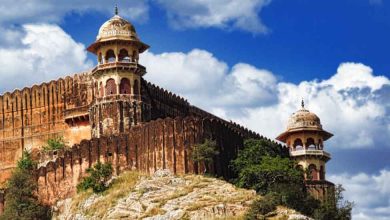
The minute you see a picture of the Chittorgarh Fort, you can instantly know it is massive. It is located atop a 180-meter-high hill and covers nearly 700 acres. No wonder you need 3 to 4 hours to fully explore this fortified city of historic significance. Let’s dive into architectural and interior details.
1. Seven Massive Gates
Most forts in India have multiple gates for various purposes. Back then, different gates were used for the entry of royals, locals and other visitors. You can go to the fort through a steep road which has seven fortified gates (pols). Each gate was designed with sharp turns, narrow passages and reinforced stone walls. They were a carefully planned defence mechanism to protect the kingdom.
Padan Pol was for controlling initial access. It served as the first checkpoint for visitors, traders and enemy movement. Bhairon Pol was a heavy defensive gate with sharp turns. Do you know it was designed to expose enemies?
Next you should see Hanuman Pol. It was a military staging point with many religious symbols that boosted morale before battle. Ganesh Pol was used for formal or royal processions.
Another beautiful gate was Jodla Pol. It was a linking gate between inner defences. The gate was mainly used for allowing controlled troop movement. Lakshman Pol gave restricted access to key administrative zones. Lastly, the Ram Pol was the strongest gate. It was heavily fortified with iron spikes to repel war elephants.
2. Kirti and Vijay Stambh
Your journey to Chittorgarh Fort remains incomplete without visiting the Vijay Stambh. Also known as the Tower of Victory, it was built in the 15th century by Rana Kumbha. The 37-metre-high tower has nine storeys, connected by a narrow spiral staircase.
You can see how each level is adorned with intricately carved images. From Hindu gods and goddesses to celestial beings and mythological scenes, these carvings have tales of the bygone era. The monument truly celebrates victory while remaining deeply rooted in faith.
Right next to Vijay Stambh, you need to head towards the Kirti Stambh. The Tower of Fame was built in the 12th century. Did you know it was dedicated to Adinath, the first Jain Tirthankara? No wonder it attracts travellers from all walks of life. It also showcases the strong Jain influence back then.
3. Rani Padmini’s Palace
People from all across the globe admire Rani Padmini after learning about Jauhar. Witnessing her palace is indeed one of the best things to do in Chittorgarh. Located near the southern edge of the fort, it is surrounded by a tranquil water reservoir. You can also see blooming lotus flowers, depending on the season.
The palace reflects awe-inspiring Rajput architecture. It has open pavilions, symmetry of design and strategic placement. Do you know that many historians debate the accuracy of Rani Padmini’s story? Being one of the historical places in Rajasthan, it still continues to hold emotional power among travellers.
4. Rana Kumbha Palace
Just when you think you are done, the Chittorgarh Fort surprises you. Do not miss visiting the Rana Kumbha Palace. Being one of the most beautiful palaces in India, it was the residence of Rana Kumbha and later rulers. Built in the 15th century, the palace is believed to be the birthplace of Maharana Udai Singh.
It is also associated with the first recorded jauhar in Chittorgarh’s history. While it is in ruins, you can still spot underground chambers, massive courtyards and fortified walls. No wonder it displays both royal grandeur and human tragedy.
5. Temples Within the Fort
Along with its historic significance, you can also witness deeply spiritual temples at the fort. The first is the Kalika Mata Temple, which was originally a sun temple. It was later converted into a shrine dedicated to Goddess Kali. While it is not one of the famous temples in India, it still remains the most visited site in the fort.
You can then head to the temple dedicated to Meera Bai. Born into royalty, Meera rejected courtly luxury. She dedicated her life to Lord Krishna. The temple showcases spiritual devotion beyond royal and political boundaries. The Kumbha Shyam Temple is best known for its Vaishnavite traditions.
Some of the Shiva temples in India reside within the fort. The Samadhisvara (Tribhuvan Narayan) Temple is a Shaiva place of worship. The next is Adbuthnath Temple, dedicated to Lord Shiva. Lastly, seek blessings from Tulja Bhavani Temple. It is dedicated to Goddess Bhavani, linked with warrior worship and protection.
6. Gaumukh Reservoir
Even when the fort is an ancient construction, you are certain to be surprised by its advanced water management system. The fort initially had 80 water bodies, ensuring water security during long sieges. One of the main features of this is the Gaumukh Reservoir.
Gaumukh means the mouth of a divine cow. Hence, you can see how water flows continuously from a cow-shaped rock formation into the tank below. It was not just practical but also a sacred water source. Such engineering marvels in India tell you a lot about the fort’s ability to withstand prolonged attacks.
7. Fateh Prakash Palace
Your journey remains almost endless when you visit the Chittorgarh Fort. The Fateh Prakash Palace surprises you with its grandeur. Built in the 19th century by Maharana Fateh Singh, you get to see stunning Rajput architecture.
It is not something rugged or worn out. Instead, you can see how well elegance and artistic taste are reflected in its interiors. The palace has spacious halls, graceful pillars and domed structures.
In today’s time, the palace is home to the Government Museum. You can better understand the life of Mewar rulers at one of the unique museums in Rajasthan. It has displays of royal weapons, sculptures, paintings and local crafts. Make sure to book affordable hotels in Udaipur for a comfortable stay.
How to Reach Chittorgarh Fort?
By Air
Chittorgarh city does not have its own airport. The nearest airport is Maharana Pratap Airport in Udaipur. It is located about 94.9 kilometres away. From the airport, you can opt for taxis or buses. The journey by road takes around 2 to 3 hours. You can also book affordable hotels in Udaipur for a pleasant stay.
By Rail
Chittorgarh is well connected by rail, as it has its own junction. The Chittorgarh Station lies on the Delhi–Mumbai rail route. You can find regular trains from major cities such as Delhi, Jaipur, Udaipur, Ajmer and Mumbai.
From the railway station, the fort is about 4.5 kilometres away. You can easily book budget-friendly hotels in Ajmer or Udaipur for a comfortable time after exploring the fort.
By Road
Chittorgarh has good road connectivity with nearby cities and towns. It is connected by national and state highways to Udaipur, Jaipur, Ajmer, Kota and Ahmedabad. You can also take Rajasthan State Road Transport Corporation (RSRTC) buses or private ones. Similarly, cabs and taxis are available from most nearby cities.
Things To Know Before Visiting Chittorgarh Fort
- Wear comfortable walking shoes and light clothing. Modest dress is recommended, especially near temples.
- Carry water and snacks, as food options inside are limited.
- Do not underestimate the size. The fort is huge and walking can be exhausting. If possible, take your own vehicle or hire an auto/taxi inside the fort.
- Mobile network is limited. Download maps or info in advance.
- Without a guide, many places feel like just ruins. A good guide adds meaning.
- Photography is allowed in most areas. However, it is best to check the rules inside museums.
- Go as soon as it opens. By late morning, the heat and crowd make it tiring.
- As rest stops are few, take breaks when you find shade or seating.
- Museums, palaces and rides inside the fort are included in the ticket price. You may have to purchase another ticket for them.
Essential Information for Visiting Chittorgarh Fort
- Location: Chittorgarh, Rajasthan 312001
- Timings: 9:00 Am to 6:00 Pm
- Entry Fee: INR 40 for Indians | INR 600 for Foreigners (may vary)
- Guide: INR 500 to 1600 (negotiate well)
Best Time to Visit Chittorgarh Fort
Winter (October to March)
The best time to visit Chittorgarh Fort is during the winter season. The temperatures range from 15°C to 25°C. As the weather is pleasant and cool, you can comfortably explore the large fort complex. It is indeed one of the best places to visit in Rajasthan in December for sightseeing. It is important to note that mornings and evenings can be slightly cold, especially in December and January.
Summer (April to June)
Summers are very hot in Rajasthan. The temperature ranges from 30°C to 45°C. As the fort receives strong sunlight, exploring during this season can be exhausting. If you are still planning a journey, visit only early in the morning.
Monsoon (July to September)
Monsoon is the second-best time to visit Chittorgarh Fort. The structure comes to life with lush greenery all around. As the crowds are fewer, you can expect solace while navigating around.
The temperature ranges from 25°C to 35°C. However, humidity, occasional heavy rainfall and slippery pathways may make sightseeing difficult. With proper precautions, you can enjoy the season fully.
Get Ready for a Historical Journey!
While you know Chittorgarh Fort for bravery, battles and acts of sacrifice, there’s much more to it. Once upon a time, the fort was alive with ordinary life. Children played in courtyards, artisans carved stone and markets buzzed with trade. It is not a place of perfection but rather absolute truth. The fort stands as a monument of victory as well as a reminder that values can outlive empires.