Witness the charming blend of Rajput and Mughal architecture at the City Palace, Jaipur, one of Rajasthan’s most stunning forts. This post will take you on a journey back in time to the grandeur of the royal lifestyle.
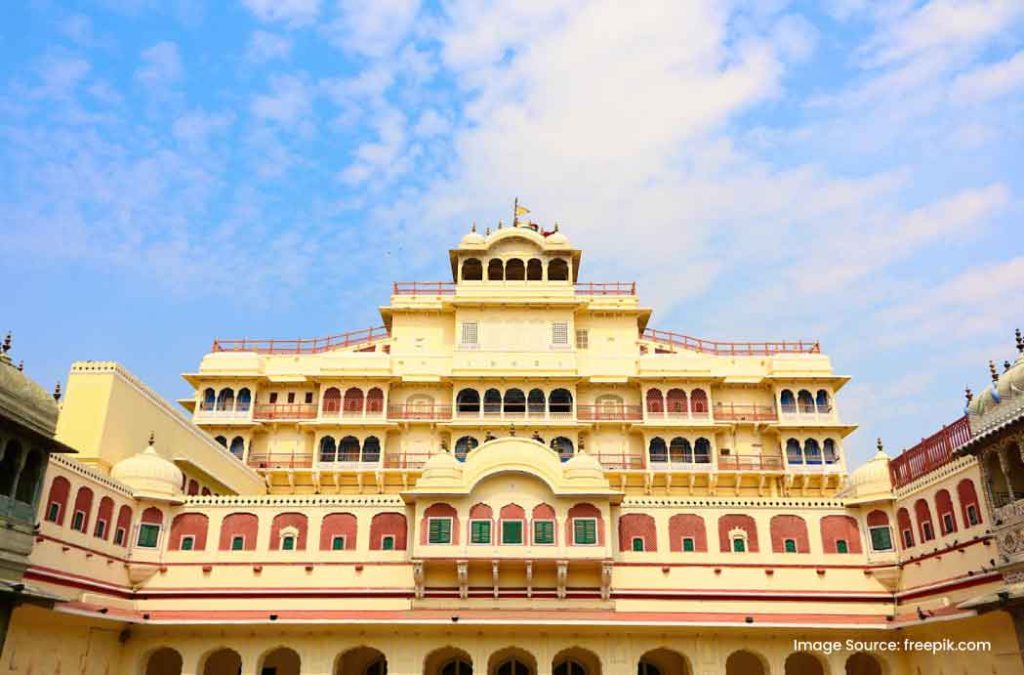
The City Palace was built in the mid-18th century by the Maharaja Sawai Jai Singh II, the founder of Jaipur. The fort stands tall as a testament to both Rajput and Mughal architecture, as it is one of the few Hindu royal court complexes that survived through the Mughal era.
The palace is still home to the last ruling royal family, which lives in a private section of the palace.








Historic Significance of City Palace, Jaipur
Located in the heart of Jaipur, the City Palace was built between 1729 and 1732 by Maharaja Sawai Jai Singh II. The palace served as the administrative and ceremonial seat of the Kachwaha rulers of Ajmer and Jaipur, making it a historically significant place in the royal history of Rajasthan.
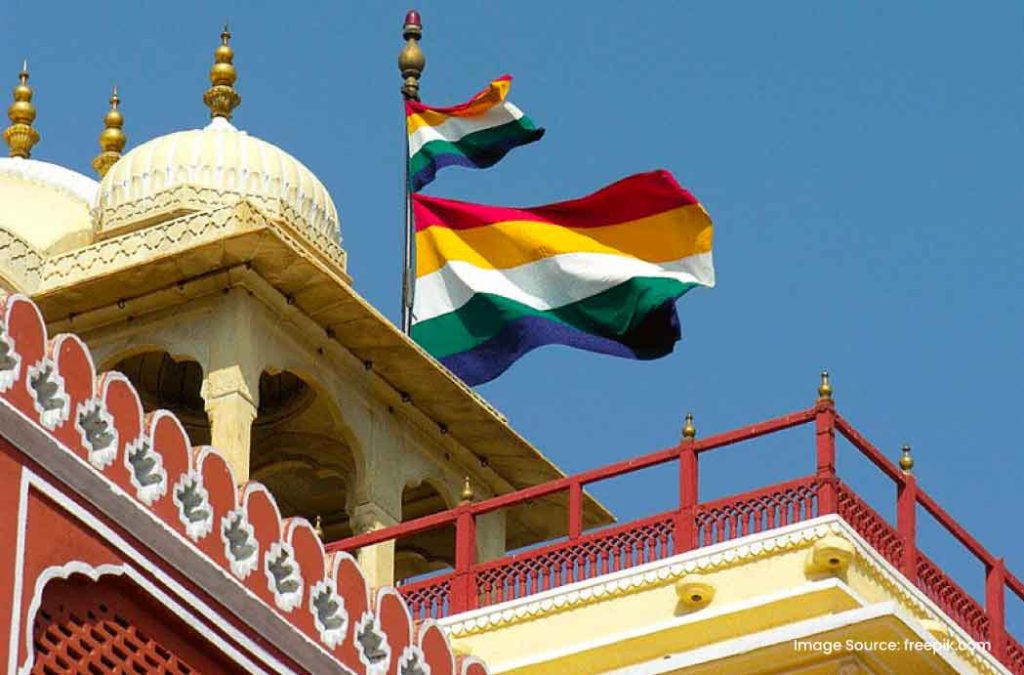
The palace complex includes gardens, courtyards and buildings holding royal heritage for centuries now. Each part of the palace has its own story to tell. Some of the key highlights of the palace are as follows:
- Virendra Pol: The main entry gate of the palace, known as the grand Virendra Pol. This 18-th century gate attracts visitors’ attention towards the intricate carvings representing the Rajput-style architecture.
- Chandra Mahal: One of the most breathtaking parts of the City Palace, Jaipur complex is this lavish seven-level architectural marvel called Chandra Mahal or “Moon Palace”. It houses the treasure troves of private royal palaces and offers a bird’s-eye view of Jaipur city. A section of the palace is still the residence of the royal family. The first floor houses the Maharaja Sawai Man Singh II Museum. The second floor is home to the iconic Sukh Niwas (Blue Room), a fully furnished royal dining hall adorned in a bright blue colour with beautiful white details. The third and fourth floors house Rang Mandir (Mirror Room) and Shobha Niwas (Hall of Beauty). The fifth floor, Chavi Niwas, was once the Maharaja’s private resting place. The sixth-floor Shri Niwas and the seventh-floor Mukut Niwas are known as the palace’s crown.
- Mubarak Mahal: Established in 1959, it is one of India’s famous museums showcasing Jaipur’s craftsmanship and regal elegance. It has a vast and unique collection of royal costumes, delicate Pashmina (Kashmiri) shawls, Menara silk saris, and other dresses featuring Sanganeri prints and folk embroidery. You will also find the clothes of Maharaja Sawai Madho Singh I on display. Other sections of the museum palace, such as Sileh Khana, Rath Khana, Painting and Photography Gallery and Friends of the Museum Gallery, showcase arms, royal vehicles, arts, portraits and live craft demonstrations.
- Rajendra Pol: A marble gateway on the right of the Mubarak Mahal is called the Rajendra Pol, which further showcases the grandeur of the palace.
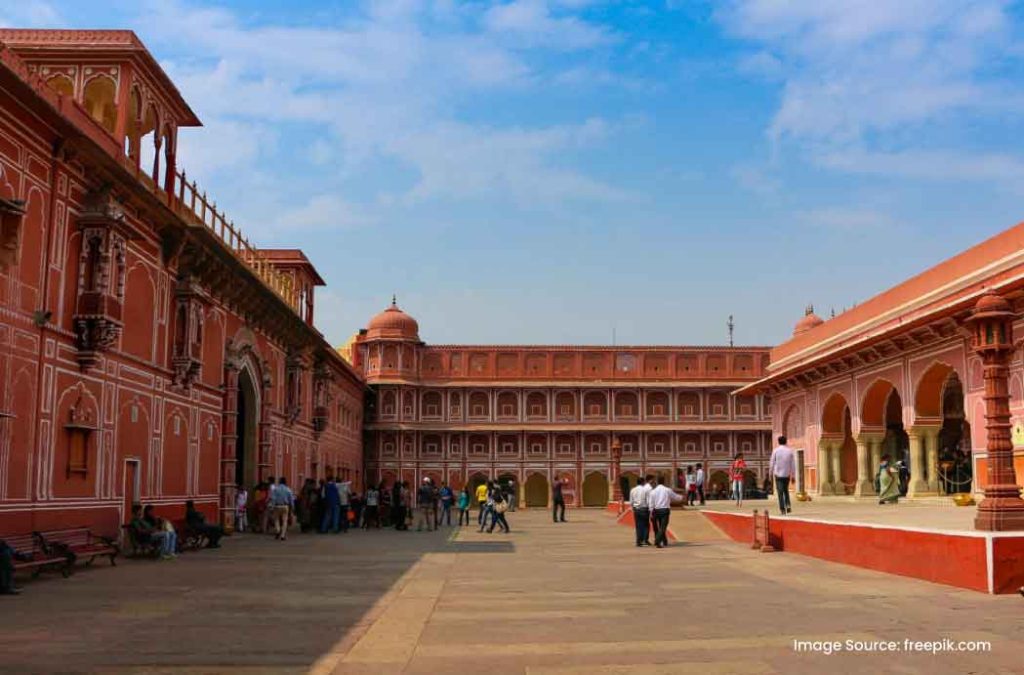
- Diwan-E-Khas: After passing through Rajendra Pol, one enters the central courtyard, which feels like a movie set. The courtyard showcases dripping crystal chandeliers, brightening the marble floors and luxurious red stone archways. At the centre lies the opulent pink Pavilion, known as the king’s hall of private audience. The pavilion used to be the centre of festivities, religious rituals and private functions.
- Maharani Palace: The palace is home to some of the well-preserved Rajput weaponry, some dating back to the 15th century. It is also adorned with beautiful and well-maintained paintings on the ceiling.
- Pritam Niwas Chowk: It is known for its four elaborately painted gates (deoris), each dedicated to a Hindu deity.
- Sabha Niwas: It used to be the central space for royal audiences and ceremonies. At present, it displaces the illuminate Jaipur’r royal history and traditions.
- Sarvato Bhadra: It is the central square of the palace, famous for its symmetry and proportion. It also houses the Gangajalis, some of the most remarkable treasures of the palace museum.
Timing, Fees and Location of City Palace Museum, Jaipur
- Timings: 9.30 AM to 7:30 PM. The Museum is closed only on Dhulandi (the second day of Holi).
- Entry Fee: For Indian citizens- INR 400 (Age Group: 13-59 years), INR 200 (Age Group: 5-12 years), INR 200 (Age Group: Above 60 years). For Foreign nationals and NRIs- INR 1200 ( Age Group: 13-59 years) and INR 600 (Age Group: 5-12 years).
- Location: The City Palace, Jaipur, Rajasthan, India, 302002.
How to Reach City Palace, Jaipur
City Palace, Jaipur, is a key attraction of the city, showcasing the royal heritage of Rajasthan. The palace is located around 4 kms from the city centre. From Jaipur city, you can either take an auto rickshaw, taxi or a local bus to get to the palace.
- By Air: The nearest airport to the City Palace is Jaipur International Airport, around 12.7 km. From the airport, you can take a cab to reach the palace directly. However, numerous hotels in Jaipur offer cab service from transit stations for convenient commuting.
- By Train: The nearest railway station to reach City Palace, Jaipur is the Jaipur Railway Station, located about 5.4 km away. The station connects the city to other major cities of the country, including Delhi, Ahmedabad, Mumbai and Kolkata.
- By Road: Jaipur has excellent connectivity to the neighbouring cities through highways and expressways. You can enjoy a comfortable long drive to reach the city. Additionally, various state and privately owned buses run regularly from the various bus stations of the city. The nearest bus station to the palace is the Sindhi Camp Bus Stand, around 5 km away.
- By Metro: Jaipur Metro is another quick and convenient way to reach the City Palace. The nearest metro station is the Chandpole Metro Station, just 1.9 km away from the palace.
Best Time to Visit City Palace, Jaipur
The City Palace, Jaipur, is spread over a vast area and requires over 2-3 hours to explore each section of the palace. The best time to visit the City Palace depends on your motive for the visit. Whether you are visiting the palace to learn about the culture and history, photography or sightseeing.
If you are a history enthusiast seeking knowledge about the craft, culture and arms, then most of your time will be spent indoors; you can visit the palace at any time of the day.
In case of sightseeing, the best time to visit the palace is during early morning and evening, when you can comfortably walk around the palace and witness breathtaking sunsets and night views of Jaipur city.
The city of Jaipur experiences extremely hot summers in March- June, obstructing your sightseeing during the daytime.
Jaipur receives moderate rainfall during the monsoon months, July-September, adding a refreshing lushness to the landscape. It is also the shoulder season for tourist so it can be considered the best time to visit the palace with fewer crowds. You can also find great deals on hotels in Jaipur for a budget-friendly trip. The winter months from October to February are considered the best due to pleasant weather, ideal for sightseeing.
In case you are looking forward to witnessing the grand festivities in the City Palace, Jaipur, Ghangaur (March), Teej Festival (July), and Dussehra (October) are the major festivals celebrated with royal customs and rituals.
Tips for Visiting City Palace, Jaipur
1. Wear comfortable shoes and clothes according to the season, since you will be walking a lot to explore the grand palace.
2. Carry a water bottle and stay hydrated, as Jaipur can get quite warm.
3. Have at least 2 to 3 hours in hand, as there is a lot to explore in the palace.
4. Photography is allowed in most areas, but do check for prohibition signs in some of the areas.
5. Guides are also available at extra charges. You can hire one for a better insight into the Palace.
6. Carry an official government-issued ID card except Aadhaar. For students, a student’s ID card is a must to avail discounts on the tickets.
Along with the City Palace, Jaipur, you can also explore some of the other historic places to visit in Jaipur, including Hawa Mahal, Jantar Mantar and Amer Fort
Moreover, you can also explore popular places to visit near Jaipur, including Ajmer and Pushkar. You can easily find affordable stays at hotels in Ajmer and hotels in Pushkar for a budget-friendly getaway.
To get the best discounts and offers on your stay make sure to book your accommodation at Treebo Club’s website or app.